What are Best Books for UPSC?
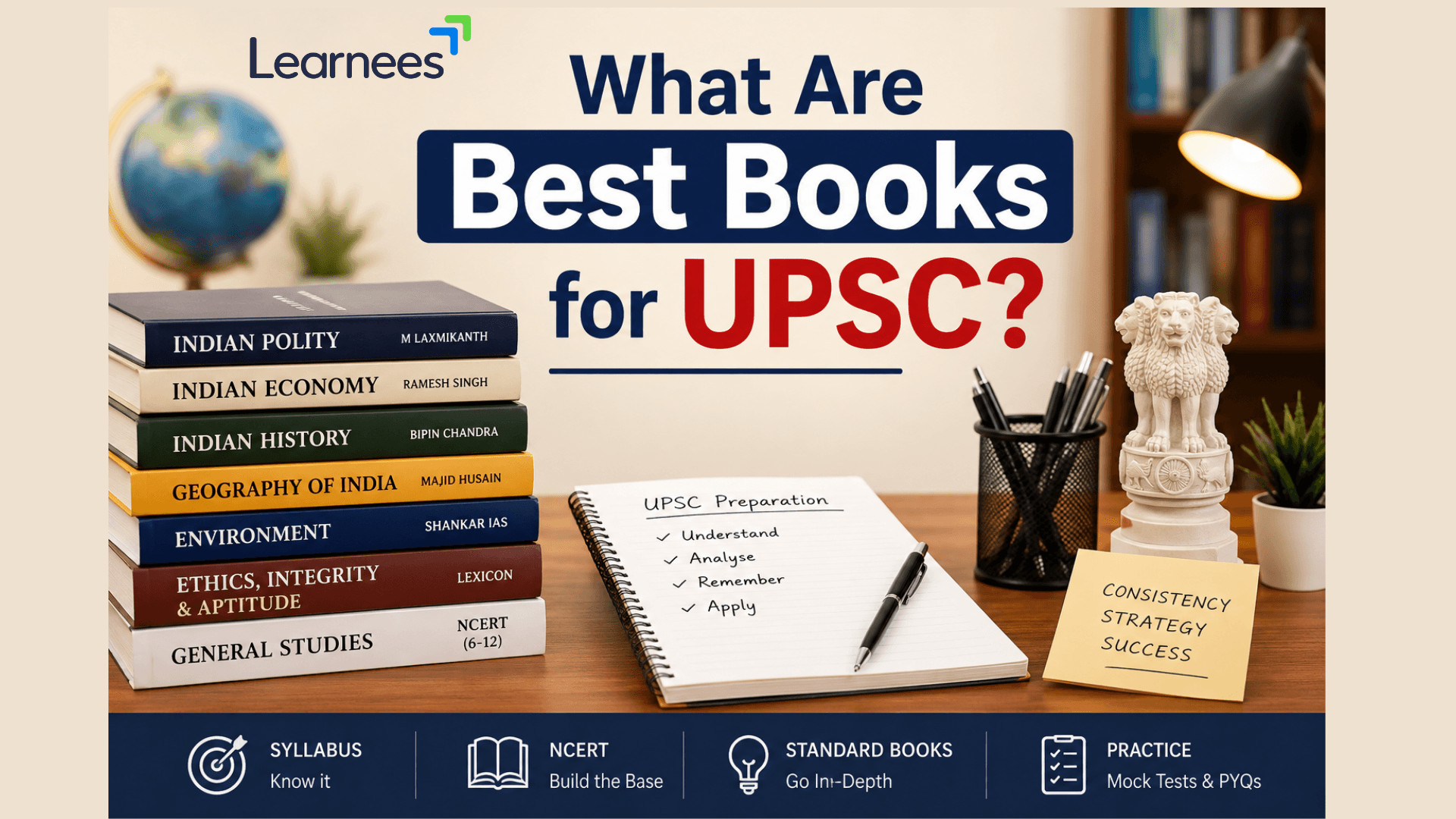

The Most Important Decision Every UPSC Aspirant Makes Before Studying a Single Page
Before the first study session. Before the schedule is made. Before the coaching is joined.
There is one decision that shapes the entire trajectory of a UPSC preparation — and most aspirants get it wrong.
Choosing the right books.
Every year, over 10 lakh aspirants appear for the UPSC Civil Services Examination. Only around 1,000 make the final selection. The difference between those who clear and those who do not is rarely about intelligence or effort. It is almost always about preparation quality — and preparation quality starts with the right resources.
The most common mistake aspirants make is what experts call "booklist hoarding" — accumulating 15 to 20 books per subject, reading none of them thoroughly. Toppers who crack UPSC in their first or second attempt consistently report revising each book at least three times rather than adding new sources closer to the exam.
The principle is simple: one standard book per subject, read multiple times, is more powerful than ten books read once.
This guide gives you exactly that — the minimum sufficient, topper-validated booklist for UPSC 2026, subject by subject, for both Prelims and Mains.
Before the Books: The Golden Rule of UPSC Preparation
Every experienced mentor, every successful topper, and every credible coaching institute gives the same advice at the start of preparation:
Begin with NCERTs. No exceptions.
NCERT textbooks — published by the National Council of Educational Research and Training — are the non-negotiable foundation of UPSC preparation. UPSC has been known to lift facts, statements, and even diagrams directly from NCERTs in Prelims questions. Skipping NCERTs and jumping to standard reference books leaves conceptual gaps that standard books alone cannot fill.
Which NCERTs to read for UPSC:

Once NCERTs are complete — and only after NCERTs — move to the standard reference books listed below.
Subject-Wise Best Books for UPSC:
1. Indian Polity
Primary Book: Indian Polity — M. Laxmikanth
Universally referred to as the "Bible of Indian Polity," this book is non-negotiable for every UPSC aspirant. It covers the Indian Constitution, Parliament, the President, the Judiciary, and all constitutional bodies in clear, accessible language. Most toppers report reading Laxmikanth four to five times — and credit it for answering 80 to 90 percent of polity questions in Prelims with confidence.
Reading strategy: Read the NCERTs on Political Science first (Class 9 to 12). Then read Laxmikanth from start to finish. In subsequent reads, focus on chapters that UPSC tests most frequently — constitutional bodies, fundamental rights, DPSP, and parliamentary procedures.
Verdict: Laxmikanth alone is sufficient for 95 percent of polity questions in both Prelims and Mains GS-II.
2. Modern Indian History
Primary Book: A Brief History of Modern India — Spectrum Publications (Rajiv Ahir)
The Spectrum book on Modern India is arguably the most popular UPSC history reference in India. From the arrival of Europeans to the Independence movement, it covers 19th and 20th century Indian history with precision and detail that matches UPSC's expectations. It is concise enough for Prelims and detailed enough for Mains GS-I answers.
For Mains (deeper coverage): India's Struggle for Independence — Bipan Chandra
Reading strategy: Read NCERTs on History (Class 8 to 10 for Modern History) first. Then Spectrum for a consolidated, exam-oriented coverage. For Mains answer writing, Bipan Chandra provides the analytical depth required.
3. Ancient and Medieval Indian History
Primary Books:
- Ancient India — R.S. Sharma (Old NCERT)
- Medieval India — Satish Chandra (Old NCERT)
R.S. Sharma's work on Ancient India is the most recommended book for UPSC history preparation covering this period. It covers the Harappan Civilisation, Vedic Age, Mauryan Empire, Gupta period, and early medieval India with scholarly depth. UPSC regularly picks questions from topics covered in this book.
Reading strategy: These Old NCERT books are relatively short and highly specific to UPSC's question patterns. Read them before moving to Art and Culture resources.
4. Art and Culture
Primary Book: Indian Art and Culture — Nitin Singhania
This is the standard reference for Art and Culture — a section that UPSC has increasingly weighted in both Prelims and Mains in recent years. It covers classical dance forms, music, painting traditions, sculpture, temple architecture, festivals, and India's intangible cultural heritage in a structured format.
Reading strategy: Art and Culture questions require visual memory and classification ability. Create a simple table-based note system — dance form, state, classical or folk, key features — and revise from notes rather than the full book in the final phase.
5. Geography
Primary Books:
- Certificate Physical and Human Geography — G.C. Leong
- Class 11 and 12 NCERT Geography (Fundamentals of Physical Geography + India: People and Economy)
G.C. Leong demystifies physical geography like no NCERT can. His explanations of landforms, climates, soils, ocean currents, and natural vegetation are clear, diagram-rich, and directly relevant to what UPSC asks. Pair this with the NCERT Geography books for complete Prelims and Mains preparation.
For Indian Geography specifically: Orient BlackSwan School Atlas — for map work, which is critical for both Prelims and Mains GS-I.
Reading strategy: Geography is a highly visual subject. Diagrams and maps must be practised actively, not just read. Understanding map-based questions is crucial for both Prelims and Mains — practice marking key physical features, industrial locations, and resource distributions for India and the world.
6. Indian Economy
Primary Book: Indian Economy — Ramesh Singh
Ramesh Singh's Indian Economy is the gold standard for UPSC Economics preparation. It covers all major topics — national income, poverty, agriculture, industry, banking, fiscal policy, and international trade — in a clear, updated format. The book is regularly revised and includes current economic data and government schemes relevant to the exam.
Additional compulsory resources:
- Economic Survey (released annually by the Ministry of Finance) — mandatory for current economic context
- Union Budget highlights — essential for Mains GS-III
Reading strategy: Read NCERT Economics (Class 9 to 12) first for foundational concepts. Then use Ramesh Singh for depth. For the final two months before the exam, supplement with the Economic Survey's summary chapters for current affairs integration.
7. Environment and Ecology
Primary Book: Environment — Shankar IAS Academy
This is the most widely used environment resource for UPSC. It covers Biodiversity, Climate Change, Environmental Laws and Conventions, Pollution, Ecosystem Ecology, and India-specific environmental issues in a structured, exam-oriented format.
Additional resource:
- Shankar IAS Environment notes are also available for free — useful for revision alongside the book.
Reading strategy: Environment questions in UPSC are increasingly current affairs-linked. Pair this book with regular reading of environment-related news from The Hindu and PIB to cover questions on recent international conventions, reports, and government schemes.
8. Science and Technology
Primary Resources:
- Class 6 to 10 NCERT Science
- The Hindu newspaper (Science and Technology section)
- PIB (Press Information Bureau) releases on government technology initiatives
Science and Technology does not have a single standard reference book the way History or Polity does. UPSC's S&T questions are largely current affairs-based — covering Space, Biotechnology, Defence Technology, Nuclear Policy, and Emerging Technologies (AI, Quantum Computing, and similar areas).
Reading strategy: Build your foundational concepts from NCERT Science (Class 6 to 10), and then rely primarily on current affairs reading for the dynamic and evolving sections of this topic.
9. Ethics, Integrity and Aptitude (GS Paper IV — Mains Only)
Primary Book: Ethics, Integrity and Aptitude — G. Subba Rao and P.N. Roy Chaudhury
Alternative: Lexicon for Ethics, Integrity and Aptitude — Chronicle Publications
Ethics is a Mains-only paper (GS Paper IV) but one that can significantly differentiate your Mains score. The paper tests conceptual understanding of ethics and its application to administrative situations — not rote recall. Many toppers score 120 to 140 marks in this paper with the right approach.
Reading strategy: Read one standard ethics book thoroughly for conceptual clarity. The more important practice for Ethics is answer writing — specifically case studies, which require structured ethical reasoning rather than bookish content.
10. Current Affairs
Primary Resources:
- The Hindu (daily newspaper) — the single most important current affairs resource
- Yojana Magazine (monthly) — for government schemes and policy analysis
- PIB (Press Information Bureau) — for official government announcements
- Vision IAS / Shankar IAS Monthly Current Affairs Magazine — for consolidated monthly revision
Important: Current affairs relevant for UPSC typically cover the period One & half year. Reading The Hindu daily and using a monthly magazine for consolidation is the most reliable system.
11. CSAT (Paper II — Prelims Only, Qualifying)
Primary Books:
- TMH CSAT Manual — Tata McGraw Hill
- Quantitative Aptitude for Competitive Examinations — R.S. Aggarwal
- A Modern Approach to Logical Reasoning — R.S. Aggarwal
Most important resource for CSAT: Previous Year Question Papers (PYQs) — these show you exactly what UPSC expects in terms of question style, difficulty level, and reasoning approach.
Reading strategy: CSAT requires a minimum qualifying score of 33 percent — just 66 marks out of 200. For aspirants who are strong in Reasoning and Comprehension, 2 to 3 weeks of focused PYQ practice before Prelims is sufficient. For aspirants who are weak in Quantitative Aptitude, begin 2 to 3 months before Prelims with daily structured practice.
Quick Reference: Complete UPSC Booklist at a Glance

Find the Right UPSC Coaching — On Learnees
If you are beginning your UPSC preparation or looking to join a structured programme that guides you through this booklist systematically, finding the right coaching institute is your next step.
Learnees is India's 1st Edtech Marketplace (coaching discovery and comparison platform) that helps aspirants across India evaluate UPSC coaching institutes side by side — with full transparency on:
- Course fees — complete breakdown, no hidden charges
- Faculty credentials — experience, subject specialisation, and teaching methodology
- Past results — verified data on Mains qualifiers and Interview selections
- Batch sizes — the level of individual attention available
- Course types — Foundation, Crash Course, Mains-focused, and Test Series programmes
- Student reviews — authentic feedback from current and former students
Making the right coaching decision now does not require visiting ten institutes individually. Learnees brings everything you need to compare in one place.
Visit Learnees.com to find and compare the best UPSC coaching institutes in India today.
Frequently Asked Questions (FAQ's)
Q1. Are NCERTs really necessary for UPSC preparation, or can I skip them and go directly to standard books?
NCERTs are absolutely non-negotiable for UPSC preparation, and skipping them is one of the most common mistakes aspirants make. UPSC has historically set questions directly from NCERT content — including specific facts, diagrams, and conceptual frameworks. Standard books like Laxmikanth or Ramesh Singh assume a foundational understanding of Polity and Economics that NCERTs provide. Without that base, standard books become harder to absorb and retain. The correct reading order is always: NCERTs first, then standard reference books. This sequence is validated by the vast majority of toppers.
Q2. Is Laxmikanth alone sufficient for the Polity section of UPSC Prelims and Mains?
Yes — for the vast majority of Polity questions in both Prelims and Mains, Laxmikanth is sufficient. Most experienced mentors recommend reading Laxmikanth four to five times and report that this approach covers approximately 90 to 95 percent of polity questions that UPSC asks. The only supplementary reading required is for Polity-related current affairs — constitutional amendments, Supreme Court judgements, and parliamentary developments — which must be tracked through daily newspaper reading and integrated with your Laxmikanth notes.
Q3. Which newspaper is best for UPSC current affairs preparation?
The Hindu is the most widely recommended newspaper for UPSC current affairs and is the primary source used by the majority of successful candidates. It provides in-depth coverage of governance, economy, international relations, science and technology, and environment — the core domains of UPSC's current affairs syllabus. Reading The Hindu daily, combined with a monthly current affairs magazine from Vision IAS or Shankar IAS for consolidation, and PIB for official government announcements, forms a complete current affairs preparation system.
Q4. Is it possible to crack UPSC through self-study without coaching, using only the booklist above?
Yes — many candidates clear UPSC every year through disciplined self-study using standard books, NCERTs, current affairs, and PYQs. The booklist above represents the same resources used by the majority of successful candidates, regardless of whether they joined coaching. That said, coaching provides structured guidance, faculty-directed prioritisation, peer accountability, and test series — all of which accelerate preparation significantly. Whether you self-study or join coaching, the booklist remains the same. Coaching helps you use the booklist more efficiently.
Q15. Where can I find the best UPSC coaching in Lucknow that follows a structured, syllabus-aligned curriculum?
Lucknow has a growing number of UPSC coaching institutes offering programmes from foundation level to Mains-focused and optional subject support. The challenge for most aspirants is not finding options — it is comparing them fairly, without spending weeks visiting each institute.
LEARNEES solves this problem. It is India's 1st edtech marketplace where you can evaluate top UPSC coaching institutes in Lucknow side by side — comparing fees, faculty experience, course structure, batch sizes, past results, and student reviews — all in one place.
Visit www.learnees.com to make your coaching decision with full information and complete confidence.
This blog is curated by Learnees — India's 1st Edtech Marketplace.

Written By: LEARNEES Team
Published on: 14/05/2026
