Best IAS Books Recommended For UPSC Civil Service Exam
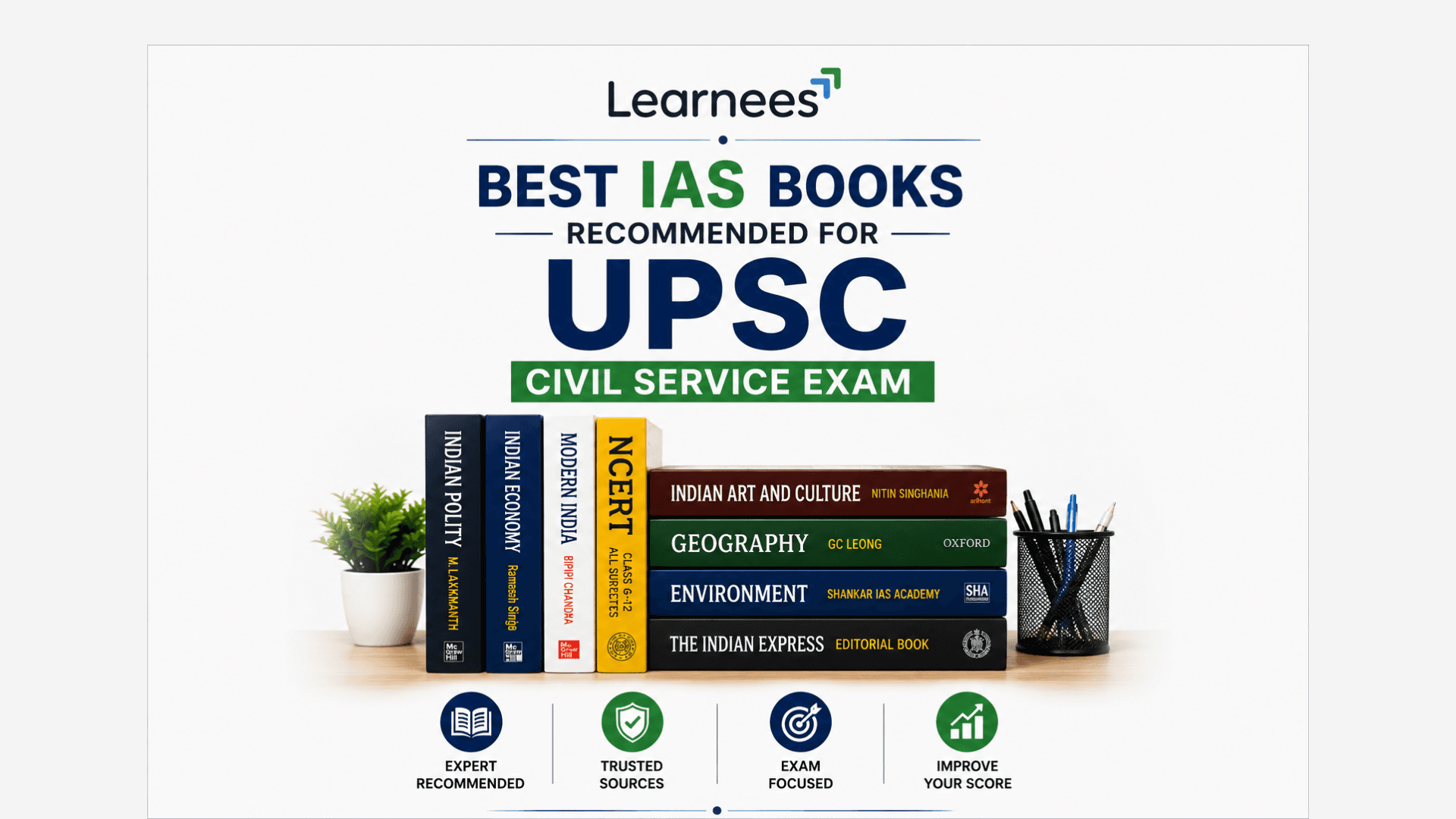

The dream of becoming an IAS officer is one of the most ambitious and respected aspirations in India. Every year, over a million candidates appear for the UPSC Civil Services Examination, yet only around 1,000 make it to the final list. The difference between those who succeed and those who don't often comes down to one thing: the right preparation strategy — and that starts with choosing the right books.
If you are a UPSC aspirant, you have probably already faced the overwhelming flood of advice, YouTube videos, coaching institutes, and booklists. Everyone seems to have a different opinion. Some say "read only NCERT." Others say "go for standard books from day one." A few insist that toppers' notes are the only way forward.
This guide cuts through the noise. It is built on what has consistently worked for thousands of successful candidates over the years. It covers every subject you need to master for Prelims, Mains, and even the Personality Test (Interview), and explains not just what to read, but how to read it and why that book matters.
Let's begin.
💡Understanding the UPSC Exam Structure Before Picking Any Book
Before you walk into a bookstore or open an online cart, you must understand what the exam demands. The UPSC Civil Services Examination has three stages:
1. Preliminary Examination (Prelims) Two papers: General Studies Paper I (100 questions, 200 marks) and CSAT Paper II (80 questions, 200 marks). Only GS Paper I counts for merit; CSAT is qualifying (33% needed). Prelims tests factual knowledge, current affairs, and analytical ability.
2. Main Examination (Mains) Nine papers in total: Essay (250 marks), GS I, II, III, IV (250 marks each), two Optional subject papers (250 marks each), and two language papers (qualifying). Mains tests depth of understanding, writing ability, and analytical thinking.
3. Personality Test (Interview) 275 marks. Tests personality, awareness, communication, and clarity of thought.
Your total score is based on Mains (1750 marks) + Interview (275 marks) = 2025 marks.
Understanding this structure tells you something important: you need books that help you both recall facts quickly (for Prelims) and think deeply and write clearly (for Mains). Not all books serve both purposes equally well. Some are excellent for building foundations. Others are best for revision. Keep this in mind as you read through this guide.
📗The NCERT Foundation: Why You Must Start Here?
The single most universally agreed-upon advice from UPSC toppers, veteran educators, and coaching institutes is this: start with NCERTs. If there is one non-negotiable rule in UPSC preparation, this is it.
NCERTs (National Council of Educational Research and Training) are school-level textbooks published by the Government of India. They are written in simple, clear language and cover every major subject in a structured, unbiased way. For a UPSC aspirant, they serve as the foundation upon which all advanced reading is built.
Here is the list of NCERTs you must read, subject-wise:Foundation: Why You Must Start Here
This principle stands as the single most universally affirmed advice from UPSC toppers and seasoned veterans.
History:
- Ancient India – Class VI (Our Pasts I)
- Medieval India – Class VII (Our Pasts II)
- Modern India – Class VIII (Our Pasts III)
- Class XII – Themes in Indian History (Parts I, II, III)
Geography:
- Class VI to X (Contemporary India I and II, The Earth Our Habitat, Resources and Development)
- Class XI – Fundamentals of Physical Geography
- Class XI – India Physical Environment
- Class XII – Fundamentals of Human Geography
- Class XII – India People and Economy
Polity:
- Class IX – Democratic Politics I
- Class X – Democratic Politics II
- Class XI – Political Theory
- Class XII – Indian Constitution at Work
Economics:
- Class IX – Economics
- Class X – Understanding Economic Development
- Class XI – Indian Economic Development
- Class XII – Introductory Macroeconomics and Microeconomics
Science (for Environment & Science-Tech):
- Class VI to X Science textbooks (selectively, especially biology and environment chapters)
Sociology (helpful for GS I and Essay):
- Class XI – Introducing Sociology
- Class XII – Indian Society
Do not underestimate these books. Many questions in both Prelims and Mains are directly or indirectly linked to NCERT concepts. Several toppers have said that if they had to choose between NCERTs and any other book, they would choose NCERTs. Read them at least twice. Make short notes. Understand, don't just memorize.
📝Best Books for History (Ancient, Medieval, and Modern India)
History is one of the most scoring subjects in UPSC if prepared correctly. It forms a major part of GS Paper I in Mains and appears consistently in Prelims.
Ancient and Medieval India
"Ancient India" by R.S. Sharma (Old NCERT) This is an older NCERT textbook but still considered a gold standard for Ancient Indian history. R.S. Sharma writes with clarity and authority. The book covers the Indus Valley Civilization, Vedic age, Mauryan and Gupta empires, religious movements, and the cultural history of India in a way that gives you a deep conceptual understanding. It is not just a list of facts; it explains causes, consequences, and connections.
"Medieval India" by Satish Chandra (Old NCERT) This book covers the Delhi Sultanate, Mughal Empire, regional kingdoms, Bhakti and Sufi movements, and the socio-economic conditions of medieval India. Satish Chandra's writing is analytical, which helps you develop arguments for Mains answers. It pairs well with the newer NCERT Class XII Themes in History books.
Modern India
"A Brief History of Modern India" by Rajiv Ahir (Spectrum) Commonly called the "Spectrum book," this is perhaps the most popular book among UPSC aspirants for Modern Indian history. It covers the entire period from 1757 to Independence in a concise, exam-oriented way. Every chapter is structured to help you recall facts quickly. It is particularly useful for Prelims. Read it after finishing the NCERT on Modern India (Class VIII and the relevant Class XII themes).
"India's Struggle for Independence" by Bipan Chandra For a deeper, more analytical understanding of the freedom struggle, Bipan Chandra's book is essential. It goes beyond dates and names to explain the ideological underpinnings of the independence movement — the role of Congress, the extremists, the moderates, the role of Gandhiji, and the mass movements. This book is indispensable for Mains answers where you are expected to analyze rather than just describe.
"From Plassey to Partition" by Sekhar Bandyopadhyay This is an advanced optional reading for candidates who want deeper insight, especially if History is their optional subject. Otherwise, Spectrum + Bipan Chandra is sufficient.
🌍Best Books for Geography
Geography in UPSC is vast. It includes physical geography, human geography, Indian geography, and world geography. Questions appear in both Prelims and GS I of Mains.
"Certificate Physical and Human Geography" by G.C. Leong This is the most recommended book for Physical Geography. G.C. Leong explains concepts like landforms, rivers, climate, ocean currents, cyclones, and soils in simple language with helpful diagrams. Read it alongside Class XI NCERT (Fundamentals of Physical Geography). The two books complement each other beautifully.
"Geography of India" by Majid Husain Majid Husain's book on Indian Geography is considered the standard text for UPSC. It covers physical features, rivers, climate, natural resources, agriculture, industries, and population of India comprehensively. This is the book to read for GS I (Geography section) in Mains.
Atlas: "Oxford School Atlas" or "Orient Black Swan School Atlas" No geography preparation is complete without an atlas. You must study the atlas regularly — political maps, physical maps, rivers, mountains, and climate regions. Make it a habit to look at maps whenever you read any geographical fact. This habit pays enormous dividends in Prelims.
NCERT Class XII – India People and Economy This NCERT covers human geography, migration, population, economic activities, and regional development with excellent maps and data. It is extremely useful for both Prelims and Mains.
💡Best Books for Indian Polity and Governance
Polity is one of the highest-scoring subjects in UPSC Prelims and an important part of GS II in Mains. It is also one of the most enjoyable subjects because it is directly relevant to everyday governance and current affairs.
"Indian Polity" by M. Laxmikant There is no alternative to this book. Period. M. Laxmikant's Indian Polity is the Bible of UPSC preparation for Polity. It covers the Constitution of India, its features, fundamental rights, directive principles, Parliament, the Executive, the Judiciary, local self-government, constitutional bodies, and much more — all in a crisp, well-organized format.
Every chapter ends with important points, and the book is written with the UPSC exam in mind. Most Polity questions in Prelims — often 15 to 20 questions — can be answered directly from Laxmikant. For Mains, you need to supplement it with current affairs and reports, but Laxmikant remains the anchor.
Read it at least twice before Prelims. During your second reading, make short notes and mnemonics. Many aspirants read it three or four times over the course of their preparation.
"Introduction to the Constitution of India" by D.D. Basu This is a more detailed and legal-oriented book, useful primarily if you are writing Law as your optional subject or want to go deeper into constitutional provisions. For most aspirants, Laxmikant is sufficient. But if a question in Mains requires constitutional interpretation, D.D. Basu gives you the analytical depth.
PRS Legislative Research and PIB For governance and policy-related questions, the Press Information Bureau (PIB) and PRS Legislative Research website are invaluable. They are not books, but they are essential reading for GS II Mains.
📒Best Books for Indian Economy
Economy is one subject where UPSC aspirants often struggle. The challenge is that it requires both conceptual clarity (theory) and awareness of current data and policy. Books alone are not enough; you must follow economic news closely.
"Indian Economy" by Ramesh Singh This is the most widely used book for Indian Economy in UPSC preparation. It covers economic planning, agriculture, industry, external sector, fiscal policy, monetary policy, banking, poverty, and more. The language is accessible, and the book is updated regularly to reflect current economic data and policies.
It is best read after completing the NCERT economics books (Classes IX–XII), which give you the foundational concepts. Ramesh Singh builds on those foundations with UPSC-specific depth and context.
"Indian Economy" by Nitin Singhania (Economy for UPSC) Nitin Singhania's book is particularly useful for the art and culture section as well (he writes on that separately), but his Economy book is an excellent supplement to Ramesh Singh. Some aspirants prefer Singhania's style for its organized, point-based format.
Economic Survey (Government of India) Published annually by the Ministry of Finance, the Economic Survey is mandatory reading for any serious UPSC aspirant. It provides an in-depth analysis of the Indian economy, government schemes, sector-wise performance, and policy recommendations. The Summary Chapter (Volume I, Chapter 1) is especially important. The Economic Survey is available free on the Ministry of Finance website.
Union Budget Every year's Union Budget — the key allocations, new schemes, and policy directions — is an important source for both Prelims and Mains. Read budget highlights and analysis from reliable sources like The Hindu, Indian Express, and government press releases.
⚡Best Books for Environment and Ecology
Environment has become one of the most important sections in UPSC Prelims over the past decade, often accounting for 15–20 questions. It is also relevant for GS III in Mains (Environment and Disaster Management).
"Environment" by Shankar IAS Academy Commonly known as the "Shankar Environment Book," this is the most popular resource for Environment and Ecology in UPSC. It covers ecosystems, biodiversity, climate change, pollution, environmental laws, and international conventions in a concise, exam-oriented manner. It is regularly updated and is widely available.
Class XII Biology NCERT (Chapters on Ecology) The last few chapters of Class XII Biology NCERT — covering ecosystem, biodiversity, and environmental issues — are essential reading. These chapters form the conceptual backbone of everything else you read about environment.
"Shankar IAS Environment" + Current Affairs Environment questions in UPSC often test knowledge of recent international conventions (like COP meetings, Ramsar sites, UNESCO designations), newly discovered species, and environmental laws. Therefore, your static reading (Shankar book + NCERT) must be complemented with current affairs follow-up throughout the year.
👨💻Best Books for Science and Technology
Science and Technology (S&T) has become increasingly important in UPSC, especially with more questions on space technology, biotechnology, defence technology, AI, and digital governance. This section does not have a single definitive textbook.
Class VI–X Science NCERTs Read selectively — focus on physics basics (light, sound, electricity), chemistry (periodic table, reactions), and biology (cell, genetics, diseases). These form the foundation.
"Science and Technology" by Ravi P. Agrahari This book is considered one of the better resources for S&T in UPSC. It covers space technology, nuclear energy, biotechnology, nanotechnology, information technology, and defence systems in a way that is accessible to non-science students.
Current Affairs (Magazines and Newspapers) No book can keep up with the pace of S&T developments. Following PIB, Science Reporter, and reliable news sources is essential. ISRO missions, DRDO developments, new health policies, and tech regulation are frequently tested.
Best Books for Art, Culture, and Society
Art and Culture forms a substantial part of GS I in Mains and also appears in Prelims (5–10 questions typically). It covers Indian classical dance and music, architecture, sculpture, literature, festivals, and folk traditions.
"Indian Art and Culture" by Nitin Singhania This is the definitive book for Art and Culture in UPSC. Nitin Singhania has created a comprehensive, well-organized, and visually-aided text that covers virtually every topic that UPSC has ever asked about Indian art, culture, and heritage. Chapters on Architecture (from Indus Valley to Colonial), Performing Arts, Literature, Festivals, Fairs, and Tribes are all covered.
Many toppers rank this as one of their favorite books because the subject, once engaged with, becomes genuinely interesting. Read it slowly and enjoy the cultural richness of India it reveals.
NCERT Class XI – An Introduction to Indian Art A useful supplement to Nitin Singhania. The NCERT provides a more structured academic perspective on Indian art history and is well-illustrated.
Best Books for Ethics, Integrity, and Aptitude (GS Paper IV)
GS Paper IV, popularly known as the Ethics paper, is unique. It tests your moral reasoning, decision-making, and understanding of ethical frameworks. It is one of the most interesting papers in the Mains exam and a significant differentiator because many candidates do not prepare it seriously.
"Ethics, Integrity and Aptitude" by G. Subba Rao and P.N. Roy Chowdhury This is the most widely recommended book for the Ethics paper. It covers foundational concepts in ethics (consequentialism, deontology, virtue ethics), public service values, attitude, emotional intelligence, moral thinkers, case studies, and more. It is well-structured and written specifically for UPSC.
"Lexicon for Ethics, Integrity and Aptitude" by Niraj Kumar The Lexicon book is a popular supplement that provides clear definitions, thinkers' quotes, and conceptual clarity. It is useful for quickly brushing up on key terms and ideas before the exam.
Attitude and Aptitude: Read Emotional Intelligence by Daniel Goleman (the relevant chapters) and familiarize yourself with the works of major moral philosophers (Kant, Mill, Gandhi, Aristotle). You don't need to read their complete works — summaries and relevant quotes from coaching notes or the above books are sufficient.
Case Studies: Practice writing case study answers regularly. This is the skill most candidates neglect. Take case studies from previous years' question papers and practice structuring your answers with stakeholder identification, ethical dilemmas, possible courses of action, and justification. This practice is worth more than any single book.
Best Books for Essay Paper
The Essay paper (250 marks) is often underestimated. Candidates who write well-structured, idea-rich, and empathetic essays can score very high here. The essay paper has two sections — each requiring one essay of about 1000–1200 words.
"151 Essays" by S.C. Gupta This book is a collection of model essays across a wide range of topics. It helps you understand the structure, flow, and depth required in a UPSC essay. Do not copy these essays; instead, study how they are organized, what arguments they make, and how they conclude.
"Essay Writing for Civil Services" by Pulkit Khare A more focused book that guides you on how to approach UPSC essay topics, develop your own arguments, and use evidence effectively. It addresses the structural and stylistic requirements of the essay paper specifically.
Reading Beyond Books: Essay writing ability comes from wide reading — newspapers (The Hindu editorial, Indian Express Ideas section), literary magazines, and quality non-fiction. Make it a habit to read one thoughtful long-form article every day. This builds vocabulary, perspective, and the ability to construct complex arguments.
Best Books for Current Affairs
Current affairs is the glue that holds everything together. Without it, static preparation is incomplete. UPSC increasingly tests the application of current events to static knowledge.
"The Hindu" Newspaper This is the single most recommended newspaper for UPSC. Read it daily, focusing on: national politics and governance, international relations, economy, environment, science and technology, and editorials. Do not read everything — be selective and strategic.
"Indian Express" Newspaper Particularly useful for its editorial and opinion section ("Ideas"). Indian Express often provides diverse viewpoints that help in essay and GS Mains answers.
Vision IAS Monthly Current Affairs Magazine Among coaching institute magazines, Vision IAS is widely regarded as one of the most comprehensive and UPSC-relevant. It organizes current events subject-wise, which makes revision easier.
Yojana and Kurukshetra Magazines (Government Publications) Yojana is a government magazine covering socio-economic issues and government schemes. Kurukshetra focuses on rural development. Both are published by the Ministry of Information and Broadcasting and are extremely useful for understanding government policy in depth. UPSC often draws questions from these magazines.
"India Year Book" (Publications Division) Published annually by the Government of India, this compendium covers every ministry, scheme, social indicator, and national achievement in detail. It is voluminous but invaluable, especially for Mains. Many aspirants study selected chapters rather than the entire book.
Best Books for Optional Subjects
The Optional subject (two papers, 500 marks) can be a game-changer. Here are book recommendations for some of the most popular optionals:
Public Administration
- "Public Administration" by M. Laxmikant
- "Introduction to Public Administration" by M.P. Sharma and B.L. Sadana
- "Public Administration in India" by B.L. Fadia
Sociology
- NCERT Class XI and XII Sociology
- "Society in India" by Ram Ahuja
- "Indian Society" by M.N. Srinivas
- "Social Change in Modern India" by M.N. Srinivas
- A.R. Desai for social movements
History (Optional)
- Bipan Chandra's "History of Modern India" and "India After Independence"
- Romila Thapar's "A History of Early India"
- Satish Chandra's "History of Medieval India"
- IGNOU study materials (BA and MA level)
Geography (Optional)
- "Human Geography" by Majid Husain
- "Physical Geography" by Savindra Singh
- "Geographical Thought" by R.D. Dixit
Political Science and International Relations
- "An Introduction to Political Theory" by O.P. Gauba
- "International Relations" by Pavneet Singh
- "Political Theory: An Introduction" by Rajeev Bhargava
Economics (Optional)
- D.N. Dwivedi for Micro and Macro Economics
- "Indian Economy" by Uma Kapila
- Datt & Sundharam for development economics
How to Read These Books: A Practical Reading Strategy
Having the right books is only half the battle. The other half is reading them effectively. Here is a practical strategy:
First Reading: Understanding Read each book once without making notes. Focus on understanding the concepts, flow, and structure. Do not stop to memorize. Your brain is mapping the territory.
Second Reading: Notes Read again and make concise notes — not copying from the book, but writing key concepts in your own words. This forces active engagement and aids memory.
Revision After making notes, revise them regularly. Many toppers follow a spaced repetition schedule — revise after 1 day, 1 week, 1 month, and 3 months. This dramatically improves retention.
Answer Writing From early in your preparation, practice writing answers. Take a concept you have studied and write a 150-word or 250-word answer as if answering a Mains question. This is the single most powerful way to test your understanding and improve your writing.
Test Series After covering a subject, take a mock test. Prelims mock tests help you identify gaps and get comfortable with multiple-choice questioning. Mains test series (from trusted sources like Insights IAS, Vision IAS, or Forum IAS) provide expert feedback on your writing.
Common Mistakes Students Make While Selecting Books
Collecting too many books: This is the most common mistake. Students buy 5–6 books on the same subject "just in case." This leads to confusion, duplication of effort, and ultimately, incomplete preparation. For each subject, stick to a maximum of 2–3 books. Master those before thinking of anything else.
Skipping NCERTs: Some students, especially those from engineering or professional backgrounds, feel they are "above" NCERT-level books. This is a costly mistake. NCERTs are the foundation. Without them, advanced books feel disconnected and harder to retain.
Ignoring answer writing: Reading books is necessary but not sufficient. UPSC rewards those who can communicate their knowledge clearly in writing. Regular answer writing practice is non-negotiable.
Chasing new books and materials: Every year, new books, new courses, and new "topper notes" flood the market. Chasing these distracts you from consolidating what you already have. Once you have a solid list, stay with it.
Neglecting revision: Reading a book once and moving on is ineffective. UPSC demands retention of enormous amounts of information over 1–2 years of preparation. Systematic revision is as important as first reading.
A Suggested Month-by-Month Booklist for Beginners
Months 1–3: Foundation
- All NCERTs (History, Geography, Polity, Economy, Science)
- M. Laxmikant's Indian Polity (first reading)
- G.C. Leong's Physical Geography
- Start daily newspaper reading (The Hindu)
Months 4–6: Standard Books
- Spectrum (Modern India)
- Bipan Chandra (India's Struggle for Independence)
- Ramesh Singh (Indian Economy)
- Nitin Singhania (Art and Culture)
- Majid Husain (Geography of India)
- R.S. Sharma (Ancient India)
Months 7–9: Specialized and Supplementary
- Shankar Environment Book
- Ravi Agrahari (Science and Technology)
- Ethics book (G. Subba Rao)
- Optional subject books
- Start Prelims mock tests
Months 10–12: Revision and Practice
- Second reading of all standard books
- Revise notes
- Full Prelims mock tests
- Mains answer writing practice
- Economic Survey and India Year Book
Topper-Recommended Books: What IAS Officers Actually Say
Interviews with IAS toppers consistently mention a few key takeaways:
- Read less, revise more. Almost every topper emphasizes revision over reading new material.
- NCERTs are sacred. Even toppers from premier institutions like IITs stress that NCERTs were their most valuable resource.
- Laxmikant is indispensable. No topper has ever said they did not read Laxmikant for Polity.
- Newspaper reading is daily discipline. The Hindu (or Indian Express) is mentioned by virtually every topper as essential daily reading.
- Answer writing makes the difference. Those who practice writing consistently always outperform those who only read.
- Optional subject must match interest. Toppers consistently chose optional subjects they genuinely found interesting, which sustained their motivation during long preparation.
Digital Resources to Complement Your Books
Books alone, in today's age, are not enough. Here are some valuable digital resources:
UPSC Official Website (upsc.gov.in): Always check for official notifications, previous year question papers, and official syllabi. The official syllabus is your map — every book you read should connect back to it.
Insights IAS (insightsonindia.com): One of the best free resources for daily current affairs, answer writing initiatives (like Secure Mains), and comprehensive study plans.
Drishti IAS: Excellent Hindi-medium resources and summaries. Their daily news analysis is high quality.
Forum IAS: Useful for peer discussion, test series, and model answers.
YouTube Channels: Unacademy, Drishti IAS, and StudyIQ offer free lectures that help reinforce concepts you have read in books.
Final Words: A Message to Every Aspirant
Preparing for the UPSC Civil Services Examination is a marathon, not a sprint. There will be days when the sheer volume of material feels impossible. There will be moments of self-doubt, frustration, and exhaustion. These are not signs of weakness — they are signs that you are attempting something genuinely difficult.
The books listed in this guide are tools. Tools, by themselves, do not build anything. It is your consistency, your discipline, and your willingness to sit with difficult material, think deeply, and write honestly that will ultimately carry you through.
Do not compare your preparation with others. Each person's journey is different. Focus on understanding, not just memorizing. Care about the subjects you study — history, economics, environment, polity — because they are the building blocks of the nation you aspire to serve.
If you are consistent, strategic, and sincere, the books in this guide are more than sufficient to take you to the top. Hundreds of IAS officers have walked this path with these exact books. You can too.
All the best. The country is waiting for its next generation of civil servants.
This blog is curated by Learnees — India's 1st Edtech Marketplace.
Visit learnees.com to explore, compare, and connect with top coaching institutes near you.
 Written By
LEARNEES Team
Published on:
20/05/2026
